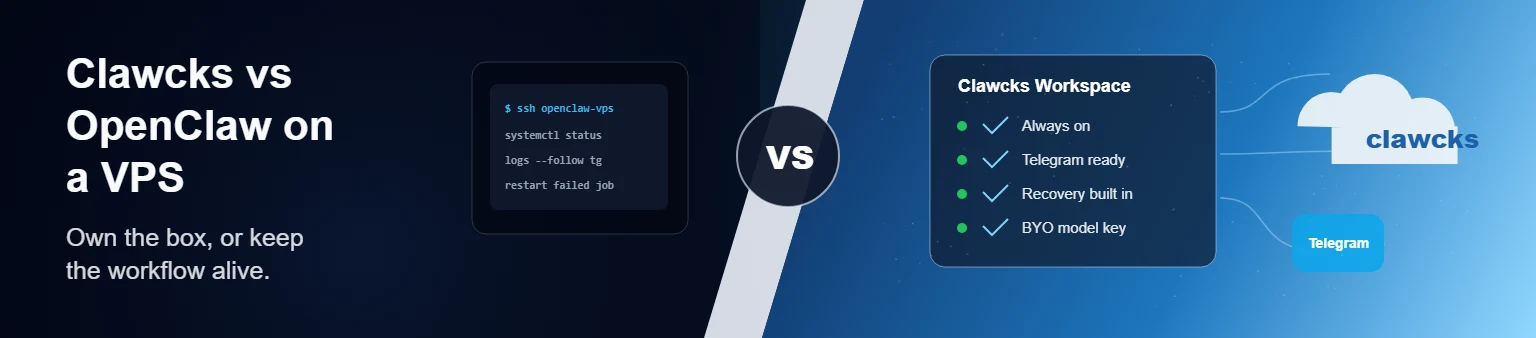
Running OpenClaw on a VPS is a valid way to keep it online. But once the agent has recurring work, connected channels, and recovery needs, you should decide whether you want cheap compute or less runtime ownership.
A VPS gives you a machine.
Clawcks gives you a product around the job the agent is supposed to keep doing.
Direct answer
Running OpenClaw on a VPS is best when you want cloud uptime but still want to manage the server, runtime, updates, secrets, logs, and recovery yourself. Clawcks is best when you want OpenClaw-style agent continuity without becoming the operator of the box behind it.
The clean split is:
- Use a VPS when control over the server is part of the job.
- Use Clawcks when keeping the workflow alive matters more than owning the server.
At a glance
| Dimension | OpenClaw on your own VPS | Clawcks |
|---|---|---|
| Best for | Builders who want cloud uptime plus server-level control | Founders, operators, and builders who want continuity without managing the stack |
| Runtime ownership | You own the box and the problems around it | Clawcks owns the hosted workspace layer |
| Setup | You provision server, install dependencies, configure OpenClaw, wire channels | Hosted workspace with fewer setup steps |
| Control | High | Lower machine-level control |
| Uptime | Better than a laptop, but still your responsibility | Hosted product path built around continuity |
| Updates and restarts | You handle them | Less direct runtime babysitting |
| Common message apps | You configure and maintain them | Easier setup for apps such as Telegram and WhatsApp |
| Logs and recovery | You define the process | Product value is reducing runtime ownership around the workflow |
| BYO key | Yes | Yes |
| Best stage | Technical users who want to self-operate production-ish agents | Users who want the agent to stay useful without operating infrastructure |
Why people choose a VPS
A VPS is not a fake alternative. It is a rational choice.
People choose it because they want:
- Cloud uptime without paying for a higher-level product.
- Direct control over the machine.
- Freedom to customize OpenClaw, plugins, routing, and deployment.
- One box that runs multiple tools side by side.
- A path that feels more serious than keeping the MacBook open.
That is all real.
The mistake is pretending the VPS removes operations.
It only changes where operations live.
What a VPS actually solves
A VPS does solve some real problems:
- Your laptop can close.
- The agent can stay online.
- Scheduled work can keep running.
- You are no longer tied to one local device.
If those are the only things you need, a cheap box can absolutely be enough.
What a VPS does not solve
A VPS does not magically turn into an agent product.
You still own:
- Provisioning and base server setup.
- OpenClaw install and dependency drift.
- Secrets and model-key handling.
- Channel setup and reliability.
- Process supervision, restart behavior, and failed jobs.
- Upgrade timing and rollback pain.
- Logs, backups, and workspace recovery.
- The weird little issues that appear only after the workflow matters.
That is the hidden comparison.
Clawcks is not cloud compute versus cloud compute.
It is self-managed agent runtime versus hosted continuity layer.
What Clawcks gives you instead
Clawcks is for the point where you do not want another server to operate.
It gives you:
- A hosted OpenClaw workspace.
- Less server setup.
- Less restart and recovery work.
- Your own model key.
- Easier setup for common message apps such as Telegram and WhatsApp.
- A path built for recurring checks, alerts, approvals, and updates.
That is the main advantage.
The agent stays useful without making you own the box behind it.
The hidden cost of the cheap box
The attraction of a VPS is simple pricing.
The hidden bill is operator attention.
The more useful the agent becomes, the more the stack picks up boring requirements:
- Notifications need to land.
- Scheduled checks need to fire.
- Provider config needs to keep working.
- The agent needs somewhere stable to keep operating.
- Failures need to be visible before they become broken workflows.
For some users, that is fun.
For many users, it becomes a tax on the reason they wanted the agent in the first place.
Who should run OpenClaw on a VPS
Choose your own VPS if:
- You enjoy operating the runtime.
- You want server-level control and are comfortable maintaining it.
- You are already running a broader self-hosted stack.
- You want to experiment aggressively with OpenClaw internals or adjacent services.
- Saving product spend matters more than saving operator time.
Who should choose Clawcks
Choose Clawcks if:
- You want OpenClaw-style agents without managing the box.
- The job depends on recurring checks, alerts, approvals, or updates.
- You care more about continuity than machine-level customization.
- You want to keep your own model key but stop babysitting the runtime.
- The agent has moved from interesting setup to useful workflow.
FAQ
Is Clawcks cheaper than running OpenClaw on a VPS?
Not always. A self-managed VPS can be cheaper in raw compute terms. The real tradeoff is whether you want to pay for productized continuity or with your own operator time.
Is a VPS enough for OpenClaw?
Yes, for many technical users. If you are comfortable provisioning, maintaining, debugging, and recovering the stack yourself, a VPS can be a good fit.
Why use Clawcks instead of Hetzner, DigitalOcean, or a cheap cloud VM?
Those services give you a server. Clawcks gives you a hosted OpenClaw workspace shaped around the workflow: always-on runtime, easier channel setup, and less runtime ownership.
Does Clawcks replace OpenClaw?
No. Clawcks is independent and not affiliated with OpenClaw. The point is to host the OpenClaw-style workflow, not replace the underlying agent environment.
Can I still use my own model key with Clawcks?
Yes. Clawcks is built around a bring-your-own-key model for OpenAI or Anthropic.
When should I move from a VPS to Clawcks?
Move when the useful part is no longer "I can run it" but "I need this workflow to keep working without thinking about the box."