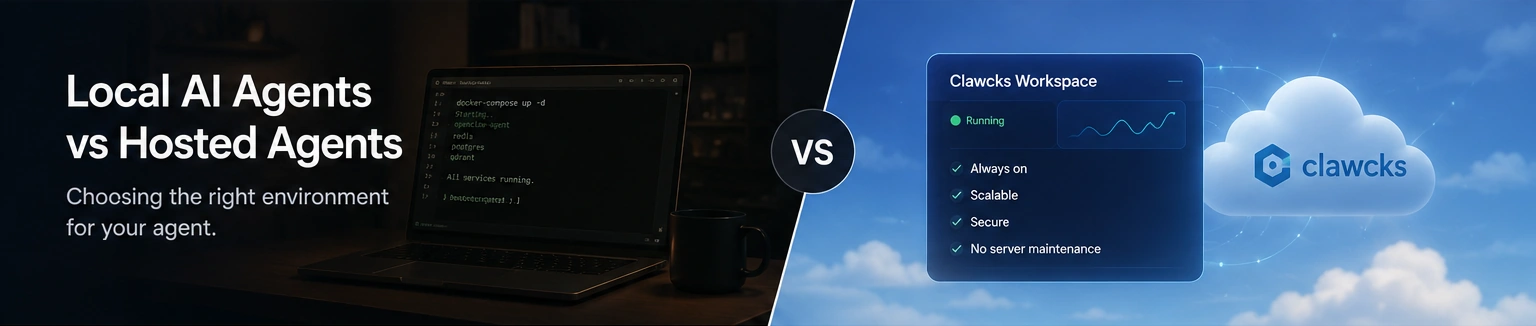
Local agents are powerful.
Hosted agents are practical.
The right choice depends on what you are trying to build, how much control you need, and whether the agent is supposed to keep working when you are not there.
Local setup gives you control
Running an AI agent locally is often the best way to learn how the system works.
You can inspect the files. You can change the configuration. You can experiment with tools, plugins, models, and runtimes. You can break things and understand why they broke.
For developers, that level of control matters.
It also makes local setup a good environment for early exploration. When the goal is to test ideas, understand the codebase, or customize the agent deeply, local is hard to beat.
But control has a cost.
You become responsible for the environment.
The hidden cost of local agents
A local agent is not just an agent.
It is also a small piece of infrastructure running on your machine.
You need the right dependencies. You need Docker or another runtime. You need storage that survives restarts. You need credentials. You need updates. You need channels. You need some way to know if the agent stopped working.
That is fine if you enjoy operating systems.
It is less fine if you just want the agent to do useful work.
The friction becomes more obvious when the agent is expected to run continuously. A local agent depends on the local machine. If the laptop is closed, the network changes, the process crashes, or the browser session breaks, the agent may stop being useful at exactly the moment it was supposed to keep working.
For a coding session, that may be acceptable.
For an agent that monitors sources, sends updates, or responds through Telegram, it is a real limitation.
Hosted agents optimize for continuity
A hosted agent starts from a different assumption.
The agent should have a stable place to run.
It should not depend on a personal laptop being online. It should keep its workspace, stay connected to channels, and be available when the user needs it.
That does not make hosted agents automatically better.
It makes them better for a different kind of job.
If the agent is meant to work in the background, check things on a schedule, send notifications, or remain reachable through a messaging app, hosting is not a luxury. It is part of the product experience.
The tradeoff is not simple
The wrong way to compare local and hosted agents is to ask which one is better.
The better question is what kind of relationship you want with the agent.
Local is better when you want maximum control, deep customization, direct access to the environment, and the ability to experiment without platform constraints.
Hosted is better when you want uptime, easier onboarding, connected channels, less maintenance, and an agent that keeps working when you are not actively managing it.
Local gives you ownership of the machine.
Hosted gives the agent a reliable home.
Both matter.
Privacy and keys
Privacy is one of the strongest arguments for local agents.
When everything runs on your own machine, you have more direct control over the environment and the data paths. For some users and some workflows, that is the right answer.
Hosted agents need to be clear about what they handle, what they store, and how credentials work.
One practical model is bring your own key.
The user keeps the model account relationship. The hosted platform provides the workspace, uptime, and connected environment around the agent.
That does not remove every privacy question, but it does separate two concerns that are often mixed together: model usage and agent hosting.
Setup time matters
There is a reason many powerful tools remain niche.
They are not too weak.
They are too hard to start using.
If the path to the first useful agent requires installing dependencies, configuring a runtime, opening ports, connecting channels, and debugging failures, many people will never reach the moment where the agent becomes useful.
This is not because they are not technical enough.
It is because setup work competes with the actual value of the product.
A hosted workspace changes the starting point.
Instead of asking the user to build the environment first, it lets them start closer to the agent’s actual job.
When local is the right choice
Local setup is still the right choice in many cases.
If you are developing the agent itself, modifying internals, testing unstable features, or handling workflows that should never leave your own machine, local is probably the better default.
It is also the right choice when learning the system deeply is part of the goal.
Running locally teaches you things that a hosted product hides on purpose.
That is not a weakness.
It is just a different goal.
When hosted is the right choice
Hosted setup makes more sense when the agent is supposed to be used, not operated.
If the agent needs to stay online, connect to Telegram, monitor sources, run scheduled tasks, or remain available while the user is away, hosting becomes part of the value.
The user should not have to think about whether the process is still alive.
They should think about what the agent is doing for them.
The real question
Local and hosted agents are not enemies.
They serve different stages and different users.
Local is where many agents are born.
Hosted is where many agents become usable over time.
The real question is not where the agent can run.
The real question is where the agent can keep working.
Where Clawcks fits
Clawcks provides hosted OpenClaw workspaces for people who want their agents online, connected to Telegram, and ready to work without managing local setup or servers.
Users bring their own model key. Clawcks provides the hosted environment around the agent.
Clawcks is independent and not affiliated with OpenClaw.