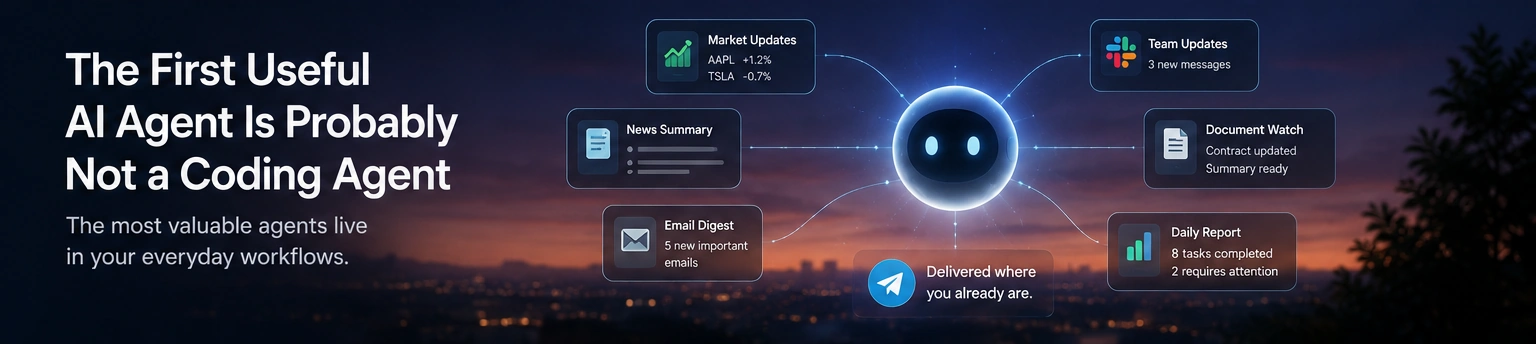
Coding agents proved that AI can act.
But the first broadly useful agents may not live inside the IDE.
They may live closer to where people already work: messages, alerts, research, customer conversations, market updates, documents, and daily operational loops.
Coding agents got there first
It makes sense that coding agents became one of the first serious agent use cases.
Software work is structured. Repositories contain context. Tests can check results. Pull requests create a review loop. Developers are comfortable with tools, terminals, APIs, and imperfect automation.
That makes coding a natural proving ground for agentic AI.
A coding agent can inspect files, make changes, run commands, and propose a patch. Even when it fails, the failure is often reviewable.
That is a big deal.
It showed that AI can move from answering questions to taking actions.
But coding is not the whole market.
It may not even be the largest one.
Most people do not live in the terminal
The average knowledge worker does not spend the day inside an IDE.
They live in email, Slack, Telegram, calendars, dashboards, documents, spreadsheets, CRMs, support systems, news feeds, and internal tools.
Their work is full of small loops:
- Check what changed.
- Decide if it matters.
- Summarize it.
- Alert the right person.
- Follow up later.
- Keep track of context.
This is agent work.
But it does not look like coding.
It looks like watching, filtering, remembering, notifying, drafting, comparing, and occasionally acting.
Those tasks are not glamorous, but they are everywhere.
The next agent interface may be messaging
If agents are going to become useful outside software development, they need to meet people where they already are.
For many lightweight workflows, that place is messaging.
A messaging interface is not perfect for everything, but it is very good for short instructions, alerts, confirmations, summaries, and quick follow-ups.
That makes Telegram, WhatsApp, Slack, or similar channels natural interfaces for many agents.
Not because they are more advanced than a dashboard.
Because they are closer to attention.
A dashboard waits for you to visit it.
A messaging channel can reach you when something matters.
The useful agent is often a watcher
Many early useful agents will probably not be heroic autonomous workers.
They will be watchers.
They will watch a market, a repo, a customer inbox, a competitor, a set of documents, a product release, a support queue, or a list of sources.
Then they will compress noise into signal.
That sounds simple, but it is valuable.
People do not suffer from lack of information.
They suffer from information arriving at the wrong time, in the wrong place, without enough context.
A useful agent can help with that.
Not by replacing judgment.
By preparing the ground for judgment.
This requires continuity
A watcher agent cannot be useful if it only wakes up inside a temporary chat session.
It needs to remember what it saw before. It needs to run on a schedule. It needs access to tools and channels. It needs to notify the user without waiting for a prompt.
That is why hosting matters.
The interesting part is not only where the model runs.
It is where the agent lives.
If the agent is supposed to monitor the world, it needs to be online when the world changes.
Developers are not the only builders
There is another reason coding agents may not be the whole story.
Many useful agents will be built by people who understand a workflow deeply, even if they are not professional software developers.
A founder may know exactly what signals matter in the market.
A recruiter may know which candidate patterns are worth watching.
An investor may know which filings, earnings calls, or product announcements deserve attention.
A support lead may know which customer messages indicate risk.
These people may not want to operate infrastructure.
But they may know exactly what an agent should look for.
The opportunity is to let them define the work without forcing them to manage the runtime.
OpenClaw points beyond coding
OpenClaw is interesting because it is not limited to a single app or a narrow workflow.
It can become a general environment for agents that use tools, channels, memory, and scheduled work.
That makes it relevant beyond the coding-agent category.
The question is not only whether an agent can write code.
The question is whether an agent can become useful in the messy, ongoing workflows where people already spend their time.
That is where a lot of agentic AI will be tested.
Not in demos.
In recurring work.
The first useful agent may be boring
The first agent someone relies on every day may not be the one that writes an entire application.
It may be the one that tells them what changed overnight.
The one that catches a customer issue early.
The one that summarizes a noisy feed.
The one that watches a competitor.
The one that prepares a short briefing before a meeting.
The one that keeps running when they are not there.
That kind of agent may look boring from the outside.
But boring tools often become infrastructure.
Where Clawcks fits
Clawcks provides hosted OpenClaw workspaces for people who want their agents online, connected to Telegram, and ready to work without managing local setup or servers.
Users bring their own model key. Clawcks provides the hosted environment around the agent.
Clawcks is independent and not affiliated with OpenClaw.